
Stress-Free Filing Explained
Understand stress-free tax filing in plain English. From unfiled returns to IRS letters, learn how to take control and file correctly the first time.
Deborah Olson
11/2/20258 min read
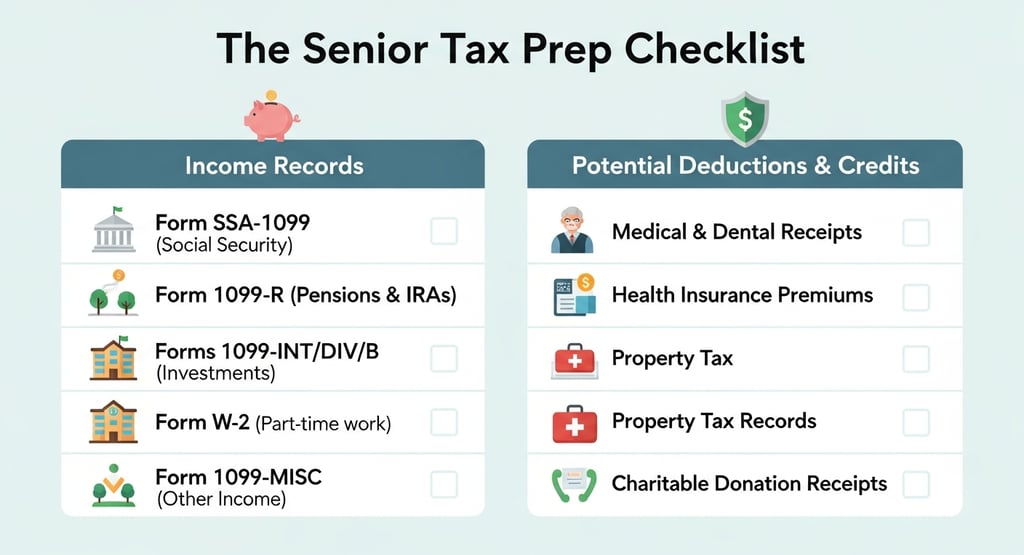
Use this checklist to gather all your essential income and expense documents before you start filing.
A stress-free tax season begins with organization. Having all your necessary paperwork in one place before you start your tax return preparation prevents last-minute scrambling and ensures accuracy. This checklist covers the key documents you will likely need.
Income Records You’ll Need: From Pensions to Social Security
Your income in retirement may come from various sources. It's essential to collect all relevant forms to report your income correctly.
Form SSA-1099, Social Security Benefit Statement: Details the Social Security benefits you received during the year.
Form 1099-R, Distributions from Pensions, Annuities, Retirement or Profit-Sharing Plans, IRAs, Insurance Contracts, etc.: You’ll receive this for payments from pensions and retirement accounts.
Form 1099-INT, 1099-DIV, and 1099-B: These report interest income, dividends, and capital gains from investments.
Form W-2: If you worked part-time, you'll need this from your employer.
Form 1099-MISC or 1099-NEC: For any income from freelance or contract work.
Documentation for Potential Deductions and Tax Credits
Gathering records of your expenses is how you can reduce your taxable income and claim valuable tax credits.
Medical and Dental Expenses: Receipts for doctor visits, prescription drugs, health insurance premiums (including Medicare), and long-term care insurance premiums.
Charitable Contributions: Official acknowledgment letters from charities for cash and non-cash donations.
State and Local Taxes: Records of property taxes and state income or sales taxes paid.
Other Potential Deductions: Records of any other deductible expenses, such as contributions to an IRA if you are still working.
Essential Personal Information and Previous Tax Returns
Having your basic information ready simplifies the filing process, whether you do it yourself or get tax assistance.
Personal Identification: Social Security numbers and dates of birth for yourself, your spouse, and any dependents.
Bank Account Information: Your bank's routing number and your account number for a faster direct deposit of any refunds.
Last Year's Tax Return: A copy of your federal and state tax returns from the previous year serves as a helpful reference.
Step 2: Unlocking Senior-Specific Tax Advantages and Benefits
The tax code includes several provisions designed to provide financial relief to older adults. Understanding these deductions and credits is key to minimizing your tax liability and maximizing potential refunds.
The Enhanced Standard Deduction for Older Adults
Filers aged 65 or older are entitled to a higher Standard Deduction. This means you can reduce your taxable income by a larger amount than younger filers without having to itemize. The additional amount is available to both you and your spouse if you are both 65 or older and filing jointly. This simplifies tax preparation for many seniors, as it often eliminates the need to track and itemize every single deduction.
Understanding the Credit for the Elderly or Disabled (Schedule R)
This is a valuable tax credit specifically for seniors and individuals with disabilities who have limited income. A tax credit is more beneficial than a deduction because it directly reduces the amount of tax you owe. To qualify, you must be 65 or older or retired on permanent and total disability. The credit is based on your filing status, age, and adjusted gross income (AGI), with specific income limits set by the IRS.
Decoding Social Security Benefits Taxation (Publication 915, SSA-1099)
Whether your Social Security benefits are taxable depends on your "combined income." This is calculated by taking your adjusted gross income, adding non-taxable interest, and then adding one-half of your Social Security benefits. If this total exceeds a certain threshold, a portion of your benefits will be subject to income tax. You'll use your Form SSA-1099 to report this income, and IRS Publication 915 provides detailed worksheets to help determine the taxable amount.
Navigating Required Minimum Distributions (RMDs) from Retirement Accounts
Once you reach a certain age (currently 73), you are generally required to take Required Minimum Distributions (RMDs) annually from your traditional IRAs and 401(k)s. These distributions are taxed as ordinary income. Failing to take the full RMD amount can result in a significant penalty. It’s crucial to calculate this amount correctly and withdraw it by the deadline to stay in compliance.
Other Key Deductions: Medical Expenses, Long-Term Care, and More
For seniors who have significant medical costs, itemizing deductions may be more advantageous than taking the standard deduction. You can deduct the amount of qualifying medical expenses that exceeds 7.5% of your AGI. This can include doctors' fees, hospital care, prescription drugs, and even premiums for long-term care insurance, up to certain age-based limits.
Step 3: Choosing Your Filing Method: What’s Best for You?
Seniors have several excellent options for tax return preparation, ranging from free, expert-led assistance to user-friendly software. The best choice depends on your comfort with technology, the complexity of your finances, and your personal preference.
Free Tax Assistance Programs: Community Support for Seniors
Several trusted, IRS-sponsored programs offer free tax help to eligible individuals.
AARP Foundation Tax-Aide: This program provides free tax preparation for taxpayers of all ages, with a focus on those 50 and older and individuals with low to moderate income. All Tax-Aide sites are staffed by IRS-certified volunteers.
Volunteer Income Tax Assistance (VITA): VITA sites offer free basic tax return preparation to people who generally make $64,000 or less, persons with disabilities, and limited English-speaking taxpayers.
Tax Counseling for the Elderly (TCE): TCE provides free tax help, particularly for those who are 60 years of age and older, specializing in questions about pensions and retirement-related issues unique to seniors. An IRS-certified volunteer can provide invaluable guidance.
Filing Online with IRS Direct File: A Modern, Free Option
For tech-savvy seniors with simpler tax situations, the IRS Direct File program offers a new way to file federal tax returns directly with the government for free. This system guides you through a step-by-step process and is available in select states. It is designed to be mobile-friendly and straightforward, offering another excellent no-cost filing option.
Self-Preparation: Using Software (TurboTax, TaxSlayer) or Paper Forms (Form 1040-SR)
If you prefer to handle your own taxes, popular software programs offer guided preparation that simplifies the process and helps identify potential deductions. For those who prefer paper, the IRS offers Form 1040-SR, U.S. Tax Return for Seniors. This form features a larger font and a clearer layout but includes the same line items as the standard Form 1040.
Hiring a Professional Tax Preparer: When Expert Support is Worth It
If your financial situation is complex—perhaps involving investment properties, small business income, or intricate estate planning—hiring a qualified professional like a Certified Public Accountant (CPA) or an Enrolled Agent (EA) may be the best choice. Their expertise can provide peace of mind and potentially uncover tax savings you might have missed.
Step 4: Accurate Filing, Refunds, and What to Expect Next
Once your return is prepared, the final steps involve a careful review and submission. Understanding what happens after you file can help you manage your expectations regarding refunds or payments.
Double-Checking for Accuracy: The Key to Avoiding Errors
Before submitting your return, review it carefully. Common errors include incorrect Social Security numbers, math mistakes, or misspelled names. An accurate return is processed faster and reduces the chance of receiving a notice from the IRS. If you're using a tax assistance program, the IRS-certified volunteer will perform a quality review.
Understanding Your Refund: Direct Deposit for Faster Access
If you are due a refund, the fastest way to receive it is through direct deposit into your bank account. The IRS can issue most electronically filed refunds in less than 21 days. You can track the status of your refund on the IRS website using the "Where's My Refund?" tool.
What to Do If You Owe Money: Payment Options and Deadlines
If your tax return shows you owe money, the payment is due by the April 15th tax deadline, even if you file for an extension. The IRS offers several payment options, including direct debit from your bank account, paying by credit or debit card, or using their Direct Pay system online.
The Benefits of Electronic Filing (E-File) for Seniors
E-filing your tax return is more secure, accurate, and faster than mailing a paper return. The software and systems used for e-filing perform basic calculations and catch common errors, reducing the likelihood of mistakes. It also provides confirmation that the IRS has received your return.
Protecting Yourself: Recognizing and Avoiding Senior Tax Scams
Seniors are often prime targets for tax-related scams. Staying vigilant and knowing the signs of fraudulent activity is essential to protecting your personal and financial information during tax season and beyond.
Common Tax Scams Targeting Older Adults: What to Look For
Scammers often use high-pressure tactics to create a sense of urgency. Be wary of aggressive phone calls, threatening emails, or text messages claiming to be from the IRS. Common scams involve demands for immediate payment via gift card or wire transfer, threats of arrest or deportation, or unexpected "refund" notifications that ask for your personal information.
How the Internal Revenue Service (IRS) Actually Contacts You
The IRS's primary method of initial contact is through physical mail delivered by the U.S. Postal Service. The IRS will not initiate contact with you by email, text message, or social media to request personal or financial information. They will never call to demand immediate payment or threaten you with law enforcement.
What to Do If You Suspect a Scam: Reporting to the IRS and CFPB
If you receive a suspicious call, hang up immediately. If you get a phishing email or text, do not click on any links or open attachments. You should report the incident to the Treasury Inspector General for Tax Administration (TIGTA) and the Federal Trade Commission (FTC). Forward suspicious emails to phishing@irs.gov.
Best Practices for Protecting Your Personal and Financial Information
Always use secure internet connections when filing your taxes. Never share your Social Security number or financial details over the phone or via email. Use strong, unique passwords for any online tax software accounts. When using free tax help services like Tax-Aide, ensure you are at an official, vetted site.
Looking Ahead: Smart Tax Planning for Next Year
Tax preparation isn’t just a once-a-year event. By thinking about your taxes throughout the year, you can make smarter financial decisions. Consider adjusting your withholdings from pensions or Social Security benefits to avoid a large bill next year. Keep your important documents organized in one place as they arrive. Proactive planning is the ultimate path to a truly stress-free tax season next year.
Your Comprehensive Guide to Tax Prep for Seniors: Stress-Free Filing Explained
Introduction: Your Stress-Free Path to Tax Season
Tax season can feel daunting, especially when navigating the unique financial landscape of retirement. With changes in income sources, from Social Security to pensions, and a tax code full of specific rules for older adults, it’s easy to feel overwhelmed. The goal is no longer just about filing; it’s about filing accurately, maximizing your return, and protecting your financial well-being without unnecessary stress. This guide is designed to transform tax preparation from a source of anxiety into a manageable and empowering process.
Why This Guide is Your Go-To Resource for Accurate Filing
This comprehensive guide breaks down the entire tax process into clear, actionable steps tailored specifically for seniors. We will demystify complex topics, highlight key tax benefits you may be entitled to, and connect you with reliable, often free, resources. By focusing on organization, senior-specific advantages, and secure filing methods, we provide a roadmap to help you handle your tax returns with confidence and peace of mind.
Navigating Tax Season: Key Dates and What to Expect for Older Adults
Tax season typically begins in late January when the IRS starts accepting tax returns, with the primary filing deadline falling on or around April 15th. For seniors, this period involves gathering specific documents that reflect retirement income. It's a crucial time to review your financial picture from the past year and take advantage of tax provisions designed for older Americans, ensuring you don’t pay more income tax than necessary.
Step 1: Gathering Your Essential Documents (The Senior Tax Prep Checklist)